Trigger
booking_complete
Timing
Immediately
Fires
email_sent · demo_confirmation
Confirms a meeting that already exists rather than asking for one. The only job left is getting the API reference out of them while intent is at its peak.
Booking happens on the page, in one click, because every email you make somebody open is a place to lose them. Email is the safety net underneath that, not the path through it. Seven of them, and every one ends.
booking_complete fires on the booking page
Confirmation
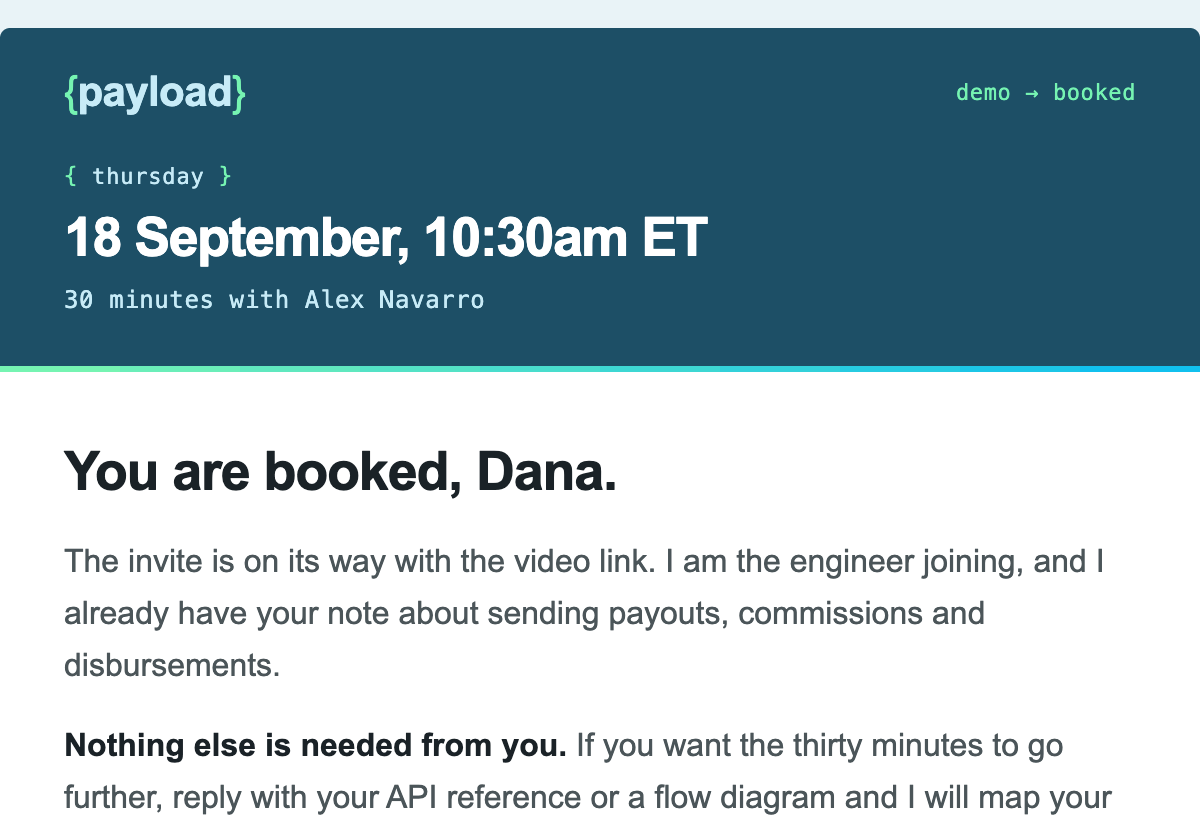
Confirmed: Thursday 10:30 with Payload
Open the real emailUntil 24 hours before the call
Reminder
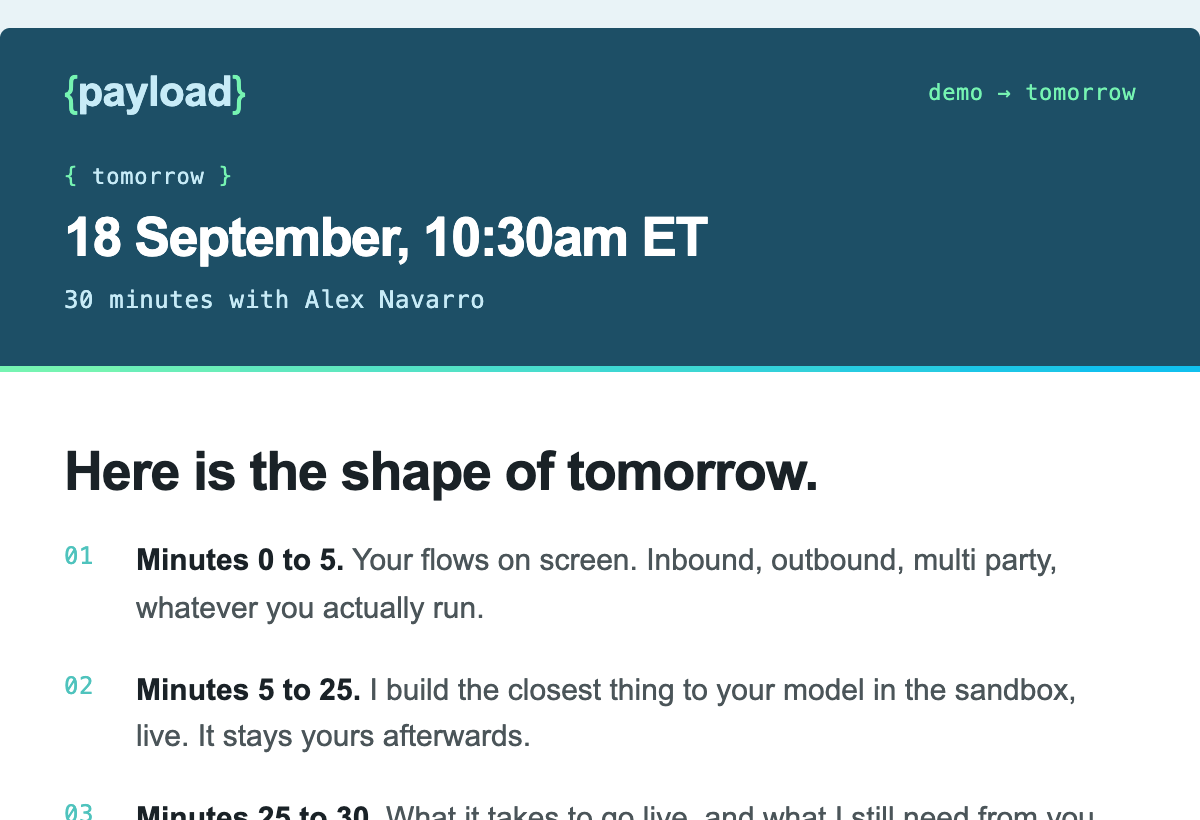
Tomorrow at 10:30: what we will cover
Open the real emailOne business day after the call
Estimate
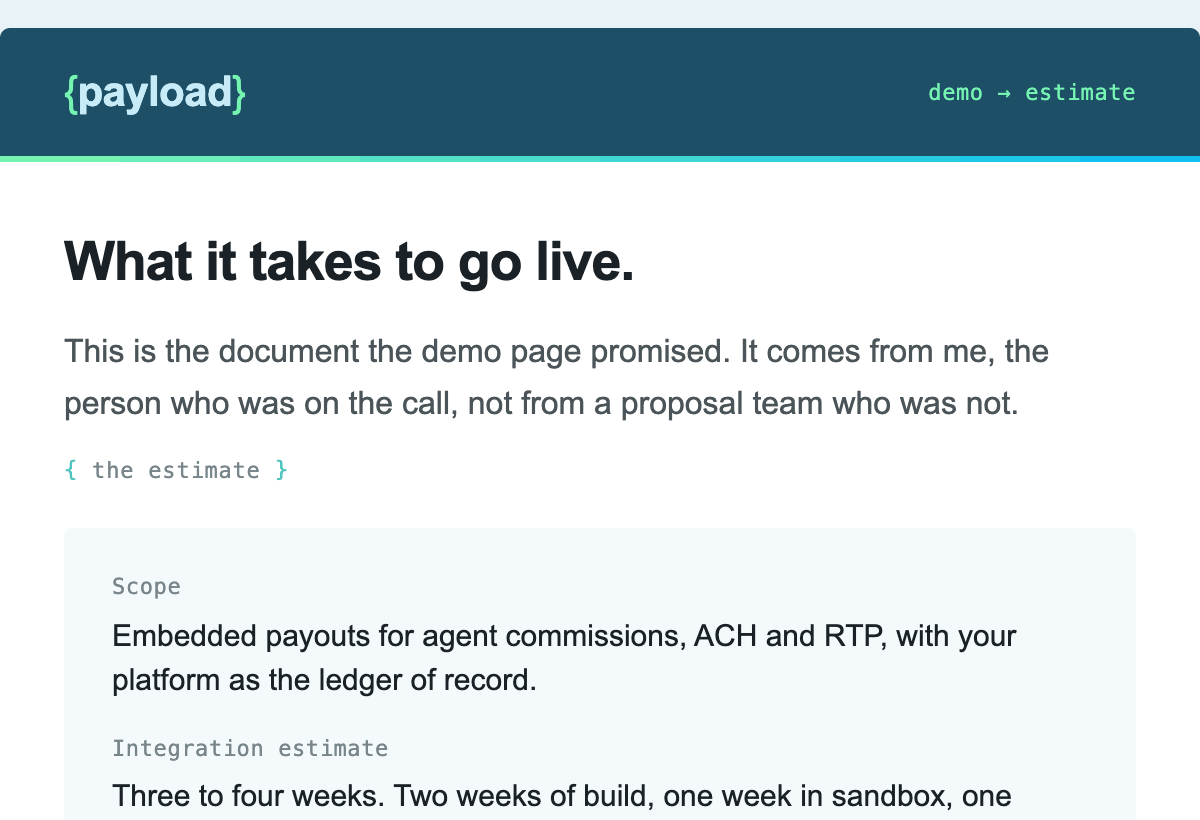
Your integration estimate
Open the real emailFourteen days with no reply
Close the file
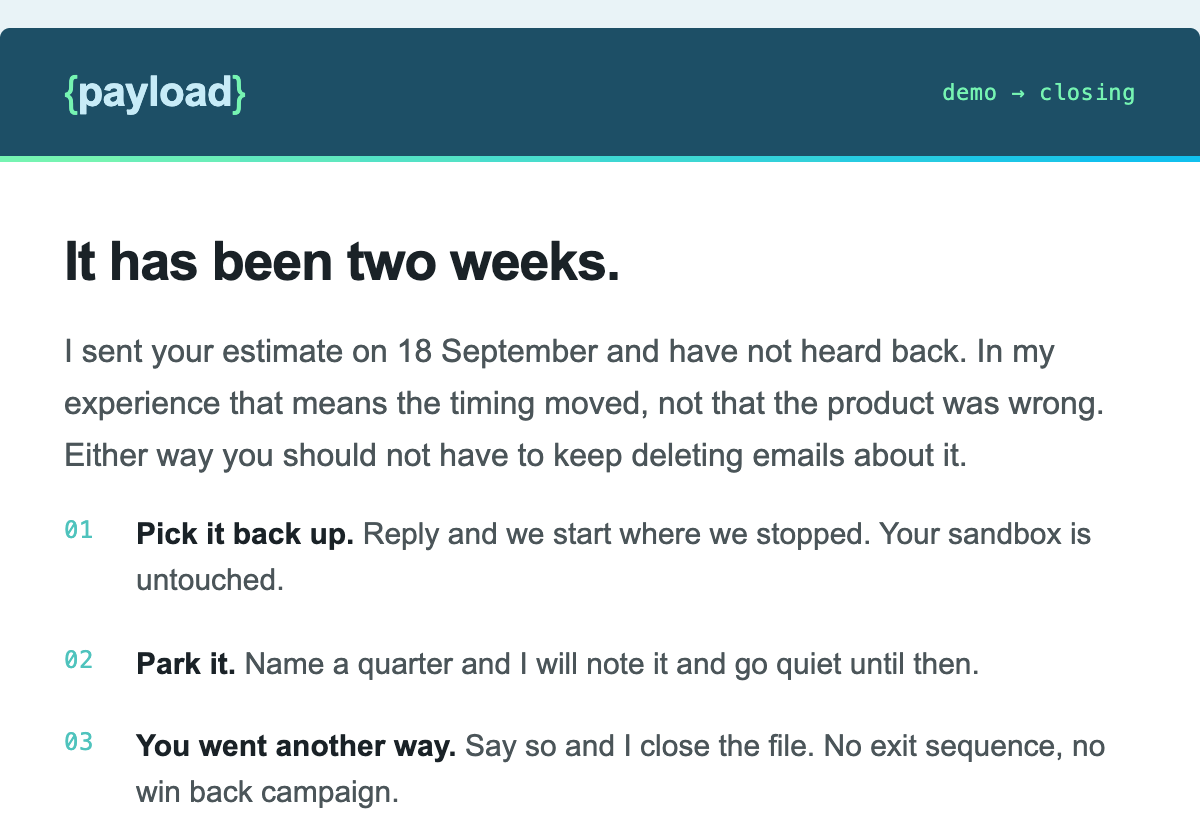
Closing this out, unless you say otherwise
Open the real emailCloses as closed_lost. Nothing else is ever sent.
The path most people take. Four emails across sixteen days, and only one of them asks for anything.
booking_complete fires, then the call is marked call_no_show
Confirmation
Confirmed: Thursday 10:30 with Payload
Open the real emailUntil 24 hours before the call
Reminder
Tomorrow at 10:30: what we will cover
Open the real emailWithin the hour of the missed call
Missed you
Missed you at 10:30
Open the real emailThree days with no rebook closes it as no_show_lapsed.
The one most funnels forget. The recovery email fires inside the hour, because a same day rebook is the only kind that converts.
generate_lead fires and booking_complete never does
Twenty four hours after the form
One nudge
Still want the thirty minutes?
Open the real emailCloses as no_booking and moves to a quarterly list a person reviews. Not a third email.
One email, on purpose. Someone who reached the calendar and closed it does not need a second ask.
lead_routed returns review, so no calendar is ever shown
Within one business day, once an engineer has read it
Not yet, and why
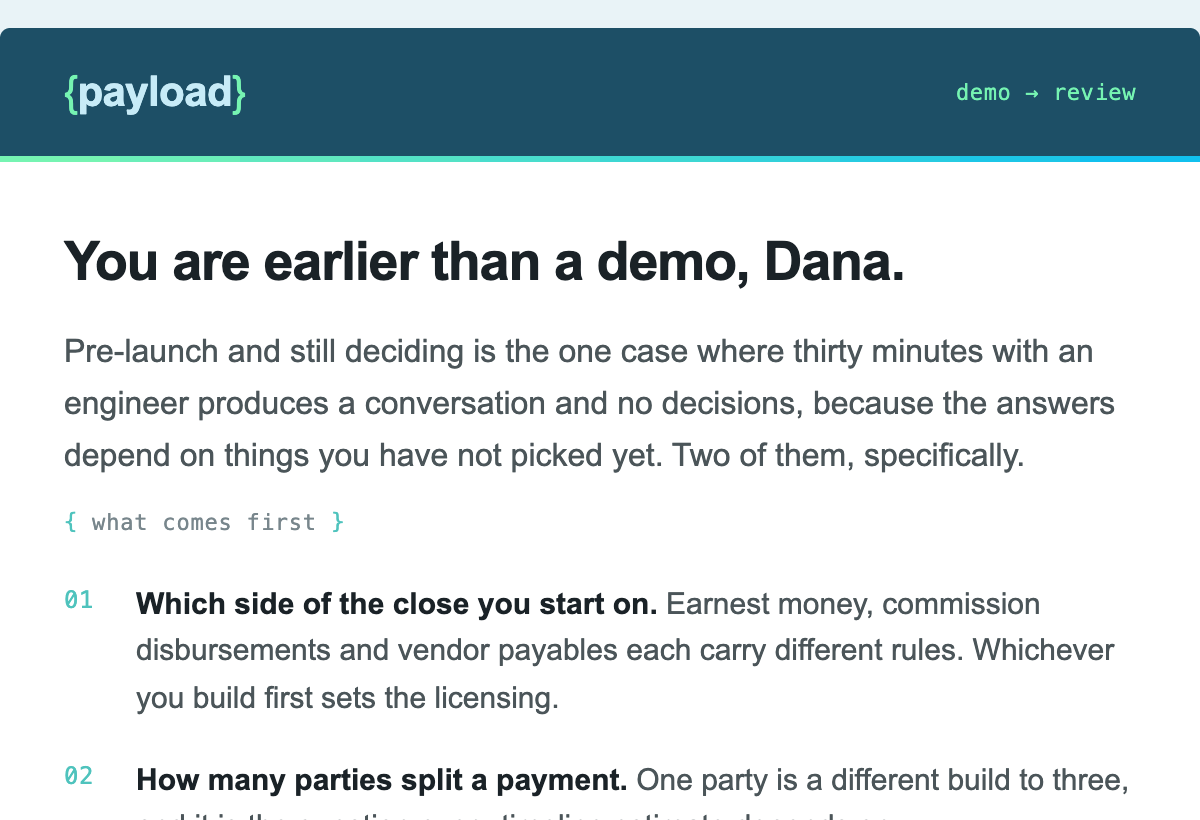
No call yet, and what I would decide first
Open the real emailCloses as too_early. Any reply re enters at the booking page, not at the form.
The path that never sees a calendar. One email, and it has to carry everything a call would have, or the gate is just a rejection with extra steps.
What never happens
Trigger
booking_complete
Timing
Immediately
Fires
email_sent · demo_confirmation
Confirms a meeting that already exists rather than asking for one. The only job left is getting the API reference out of them while intent is at its peak.
Trigger
generate_lead, no booking_complete
Timing
+24 hours
Fires
email_sent · booking_nudge
Catches the person who reached the calendar and closed it. Step one of the form captured the use case before any typing, so this email knows what they wanted even though they never booked.
Trigger
Booking exists, call tomorrow
Timing
T minus 24 hours
Fires
email_sent · call_reminder
Cut the no-show rate and make the call better at the same time. The agenda is the same three steps the demo page sells.
Trigger
Call marked complete
Timing
+1 business day
Fires
email_sent · estimate_delivered
This is the promise the whole page rests on. If this email does not ship on time, the demo page is writing cheques the company does not cash.
Trigger
No activity 14 days after estimate
Timing
+14 days
Fires
email_sent · final_check
Force a decision instead of letting the deal rot in the pipeline. Naming 'you went another way' as an option is what makes people answer.
Trigger
call_no_show
Timing
Within the hour
Fires
email_sent · no_show_recovery
Path B only. The tone does all the work: no guilt, no suggestion they wasted anyone's time, and an explicit one word way to say no. A clean no is worth more than a guilty rebook that also does not happen.
Trigger
lead_review_queue
Timing
Within 1 business day
Fires
email_sent · too_early_reply
Path D only, and the hardest one to write. The form just declined to show them a calendar, so this email has to be worth more than the meeting they did not get. It names the two decisions that come first, hands over sandbox credentials anyway, and offers to book manually once they answer.
Step one, one click
The five options are Payload's own solutions nav: real estate, legal payments, insurance, professional services, software platform. Decides the tailored paragraph and the reading. Fires form_step_complete before a character is typed, so an abandon later still reports the industry.
Step two, one click
Inbound, outbound, multi party, or still deciding. Decides which engineer takes the call and what the agenda leads with. Asking beats inferring from the email domain, which guesses wrong on every gmail.com and every holding company.
| Answer in step one | What it covers | What changes in the email |
|---|---|---|
| Real estate | Brokerage, title, mortgage, property mgmt | Earnest money and commission splits. Reading is the eXp Realty story and Payload Protect. |
| Legal payments | IOLTA, invoicing, co-counsel | Trust accounting decides the rail first. Reading is the legal payments page and Payload Protect. |
| Insurance | Premiums, commissions, claims | Premiums in and claims out on one integration. Reading is the insurance page and the Fifth Third announcement. |
| Professional services | CPA, consulting, engineering | Collections speed over cost. Reading is the professional services page and the sandbox quickstarts. |
| Software platform | Embedding payments in your product | Who holds the funds and month end reconciliation. Reading is the quickstarts and the Fifth Third announcement. |
Same email, same code path. Emails 03 and 07 branch, so the generator writes four variants of each. Emails 01, 02, 04, 05 and 06 are byte identical across every industry, so it writes none. Eight variant files rather than thirty five.
| When the meeting sits | What sends | Why |
|---|---|---|
| Three days out or more | All four. Confirmation now, reminder at T-24h, estimate, close. |
Long enough for the booking to fall out of memory, so the reminder earns its place. |
| Under three days | Confirmation now, carrying the agenda. Reminder only if T-24h is still more than six hours away. |
Two emails inside 48 hours about the same meeting reads as nagging, not service. |
| Under 24 hours | Confirmation only. It is the reminder. | Sending a "tomorrow" email about a meeting three hours from now is how automation announces itself. |
Booking is also capped at five business days out, soonest first. No show rate climbs with lead time, so the cheapest way to improve attendance is to stop offering dates three weeks away.
Every email you make somebody open is a place to lose them, and intent is highest in the seconds right after they submit. Moving the calendar onto the thank you page acts on that peak instead of posting a letter to it. Email then becomes the safety net underneath, which is a job it is good at.
Typing is the expensive part of a form, so the first screen asks for none. One click is close to the lowest activation energy a page can ask for, and once someone has answered anything, finishing feels less like a decision and more like following through. It also means an abandon at screen four still tells us who they were.
Email 05 offers three answers and says the third one, no, happens by default. People reply when refusing is easy and costs them nothing. A message that only has room for yes usually gets silence, and silence is the one answer you cannot act on.
The Fifth Third quote sits in the confirmation email rather than on the landing page. The wobbliest moment is just after someone commits, not just before, so that is where reassurance is worth the space.
The longer the gap between booking and the call, the more chances there are to forget it, double book it, or stop caring. So the picker caps at five business days and shows the soonest first. Saying that on the page turns a constraint into a reason to trust the person on the other end.
The page says there is no drip, so there is no reactivation program, no win back, and two automated emails is the ceiling. A promise that is quietly broken later is worse than never making it, and the only way to keep this one is to build nothing that could break it.